
What investors look for in an agritech prototype
African agritech funding has shrunk and changed shape. Founders with a working machine are now judged less on vision and more on whether the machine pays for itself in a farmer's field.
The money has thinned and changed form
Funding to African agritech peaked at US$483 million in 2022, fell to US$194 million in 2023, recovered slightly to about US$207 million in 2024 and declined again to US$168.1 million in 2025 (TechCabal, 2026). Investors are increasingly using debt, structured finance, grants and blended finance rather than venture equity alone, and on-farm solutions for smallholders still depend heavily on grants and concessional money (Laniyan, 2026). Across all sectors, African start-ups raised US$3.2 billion in equity and debt in 2024 (Michael, 2025).
For hardware, that shift is good news in disguise. A machine that earns predictable revenue is easier to finance with debt than an app with uncertain margins.
Seven things investors check
- A paying customer. Not a pilot partner: someone who has paid for the machine or its service and would pay again.
- Unit economics in the field. Price per hectare, per tonne or per hour, against cost per unit, at realistic utilisation. Ghana's subsidised tractor centres failed on utilisation, not technology (Houssou et al., 2013).
- Field evidence. Seasons of operation, independent test results and farmer outcomes, not only laboratory data.
- Manufacturability. A costed bill of materials, local suppliers for most parts and a route from ten units to a thousand.
- A service and parts plan. Who repairs the machine, where, and how fast. African mechanisation schemes have repeatedly stalled on parts and repairs (Daum and Birner, 2017).
- A route to market. Distributors, service providers or public programmes. Nigeria's 2026 mechanisation programme procures through service providers and plans a tractor assembly plant of 2,000 to 4,000 units a year (BusinessDay, 2026), which creates demand for local implements and parts.
- A financing model that fits the farmer. Pay-as-you-go and leasing have already put tractors with smallholders in Nigeria, Kenya and Uganda (Heifer International, 2023).
Match the capital to the stage
| Stage | What to prove | Likely capital |
|---|---|---|
| Prototype | It works on a real farm | Grants, competitions, research partnerships |
| Validated | Farmers will pay; costs are known | Grants, angels, early equity |
| Market-ready | Repeatable production and service | Equity, blended finance |
| Commercialised and scaling | Margins hold as volume grows | Asset finance, working capital debt, equity |
The red flags
- Revenue that depends on one government order.
- Critical parts that only one overseas supplier can provide.
- No answer to who fixes the machine at harvest.
- Impact claims without field data behind them.
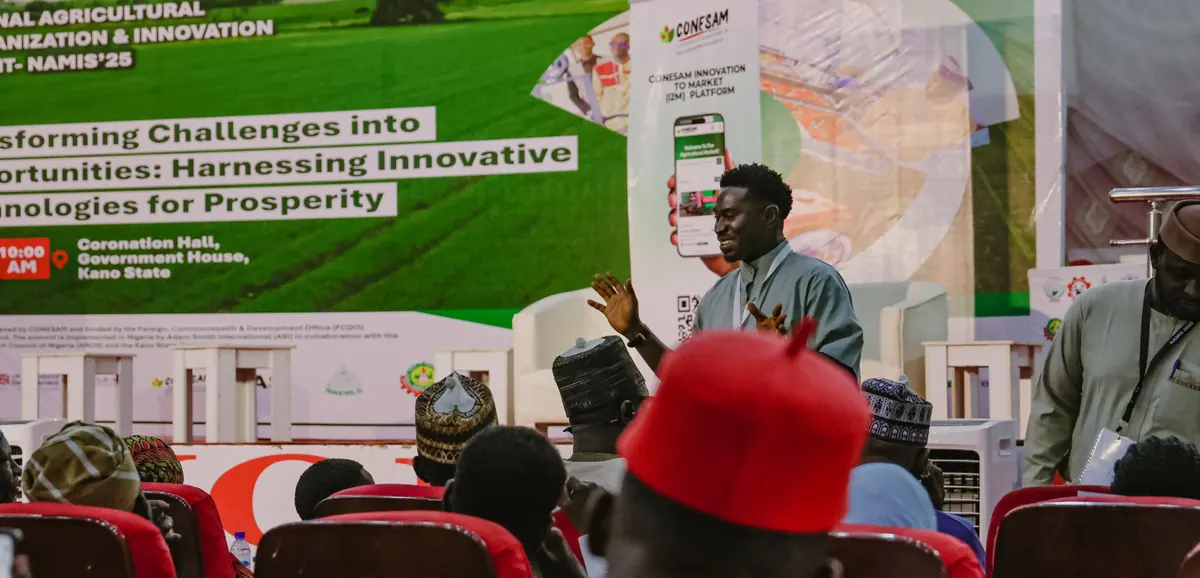
Bring your prototype to NAMIS
NAMIS 2026 puts innovators, fabricators, financiers and public buyers in one room for a day. Come with your numbers, your field evidence and a clear ask.
References
- BusinessDay (2026) 'FG flags off Africa's largest agricultural mechanisation programme, targets 1.2 million farmers', BusinessDay, 16 February. Available at: https://businessday.ng/agriculture/article/fg-flags-off-africas-largest-agricultural-mechanisation-programme-targets-1-2million-farmers/
- Daum, T. and Birner, R. (2017) 'The neglected governance challenges of agricultural mechanisation in Africa: insights from Ghana', Food Security, 9(5), pp. 959 to 979. Available at: https://doi.org/10.1007/s12571-017-0716-9
- Heifer International (2023) Mechanization for Africa: Innovative Financing for Agricultural Transformation and Youth Job Creation. Impact report. Available at: https://media-refresh.heifer.org/wp-content/uploads/HPI-Mechanization_For_Africa_-_Impact_Report.pdf
- Houssou, N., Diao, X., Cossar, F., Kolavalli, S., Jimah, K. and Aboagye, P.O. (2013) Agricultural Mechanization in Ghana: Is Specialization in Agricultural Mechanization a Viable Business Model? IFPRI Discussion Paper 1255. Washington, DC: International Food Policy Research Institute. Available at: https://hdl.handle.net/10568/153471
- Laniyan, S. (2026) 'African agtech funding drops to $170M in 2025 as debt overtakes equity for first time', Techpoint Africa, 17 March. Available at: https://techpoint.africa/?p=351261
- Michael, C. (2025) 'Investors bet on equity as African startups raise $3.2bn in 2024', BusinessDay, 31 January. Available at: https://businessday.ng/?p=932954
- TechCabal (2026) 'Agritech funding in Africa drops to $168 million in 2025 as investor interest shifts', TechCabal, 29 January. Available at: https://techcabal.com/2026/01/29/agritech-funding-in-africa-falls-to-168-million/