
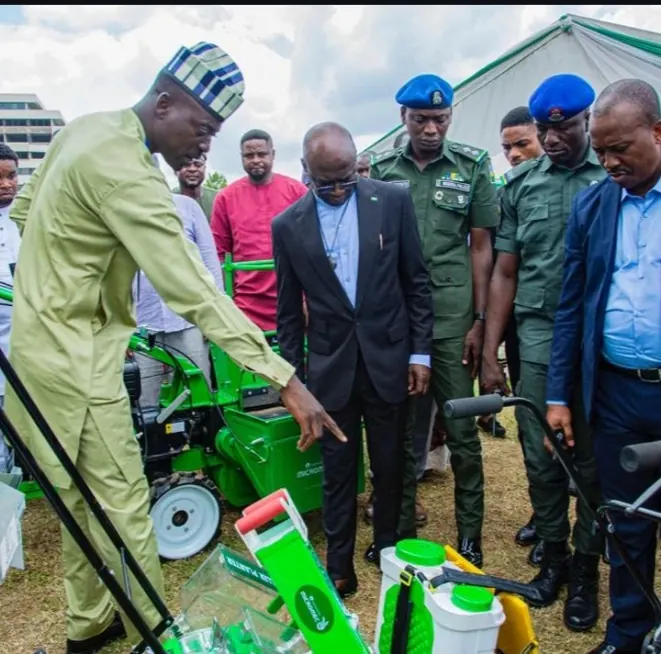
What mechanisation as a service could mean for smallholders
Nigeria's newest mechanisation programme does not give tractors away. It places them with service providers who sell ploughed hectares to farmers. For a smallholder, that shift could matter more than the number of machines.
The gap is farm power, not farmland
More than three quarters of farmers in sub-Saharan Africa still prepare land with hand tools alone, a practice that caps productivity and pushes young people away from farming (FAO and AUC, 2018). Nigeria sits near the bottom of that picture. At the February 2026 launch of the Renewed Hope National Agricultural Mechanisation Programme, the Minister of Agriculture and Food Security put national tractor density at 0.27, against an African average of 2.5, while the Bank of Agriculture estimated that over 95 per cent of farmers still rely on manual labour (BusinessDay, 2026).
Why owning a tractor rarely pays on two hectares
A tractor is an indivisible asset. Its cost is fixed whether it works 50 hectares a year or 500. In Nigeria, tractors in use tend to be large and expensive, joint ownership is rare and formal loans are hard to obtain because transaction costs are high (Takeshima, 2015). For a family farming one or two hectares, ownership is out of reach. Hiring is the only realistic route to machine power.
Mechanisation as a service turns the machine into something a smallholder can buy in small pieces: an hour of ploughing, a hectare of ridging, a tonne of threshing. The question is who runs the service and whether it survives.
What the evidence says about who should run it
A survey of tractor owner-operators in Kaduna and Nasarawa found that operators who bought tractors on the private market served larger areas at lower cost than those who received tractors through government programmes (Takeshima et al., 2015). Ghana offers the cautionary tale. Its subsidised Agricultural Mechanization Services Enterprise Centres were found not to be viable businesses even with subsidy, chiefly because the tractors worked too few hectares a year (Houssou et al., 2013). Breakdowns and slow access to parts made low utilisation worse.
The lesson is consistent: a tractor service lives or dies on utilisation. Every idle week during the planting window is revenue the operator never recovers.
The platform layer is already African
Booking technology emerged on the continent first. Hello Tractor, founded in Nigeria in 2014 and now active in 20 countries, matches tractor owners with farmers through a digital marketplace so that idle machines find work (Jehanzeb and Mabaya, 2024). With Heifer International, it piloted pay-as-you-go tractor financing that had served 21,048 smallholders in Nigeria, Kenya and Uganda by December 2022, turned 104 farmers into tractor owners and created 368 direct jobs for booking agents, operators and technicians (Heifer International, 2023).
How the 2026 national programme is designed
| Design feature | Programme detail |
|---|---|
| Fleet | 2,000 tractors and more than 9,000 implements, rolled out in three phases |
| Delivery model | Mechanisation service providers, not private allocation; each expected to work about 600 hectares a year |
| Support network | Seven mega service centres, 36 mobile workshops and maintenance hubs supplying parts and training |
| Data | IoT tracking of location, usage, fuel and maintenance on every tractor |
| Reach | More than 1.2 million farmers and 1.5 million hectares a year |
Source: BusinessDay (2026).
On paper, the design answers the failures documented in Ghana: utilisation targets, a parts and repair network, and data to see where machines sit idle.
What smallholders should look for
- Timeliness. A service that arrives three weeks after the rains is worth little. Booking systems and local agents shorten the queue.
- Right-sized implements. Large tractors suit block farms. Clustered smallholdings need operators who can move between plots without long idle transfers.
- Aggregation. Cooperatives that pool neighbouring plots give operators the continuous hectares that make the price per hectare fall.
- Transparent pricing. A posted price per hectare, agreed before the machine enters the field.
Where NAMIS comes in
Services need machines that can be repaired locally and implements built for local soils. That is the bridge NAMIS 2026 is designed to build: between the service providers who need reliable equipment and the Nigerian fabricators and researchers who can make it.
References
- BusinessDay (2026) 'FG flags off Africa's largest agricultural mechanisation programme, targets 1.2 million farmers', BusinessDay, 16 February. Available at: https://businessday.ng/agriculture/article/fg-flags-off-africas-largest-agricultural-mechanisation-programme-targets-1-2million-farmers/
- FAO and AUC (2018) Sustainable Agricultural Mechanization: A Framework for Africa. Addis Ababa: Food and Agriculture Organization of the United Nations and African Union Commission. Available at: https://www.fao.org/3/CA1136EN/ca1136en.pdf
- Heifer International (2023) Mechanization for Africa: Innovative Financing for Agricultural Transformation and Youth Job Creation. Impact report. Available at: https://media-refresh.heifer.org/wp-content/uploads/HPI-Mechanization_For_Africa_-_Impact_Report.pdf
- Houssou, N., Diao, X., Cossar, F., Kolavalli, S., Jimah, K. and Aboagye, P.O. (2013) Agricultural Mechanization in Ghana: Is Specialization in Agricultural Mechanization a Viable Business Model? IFPRI Discussion Paper 1255. Washington, DC: International Food Policy Research Institute. Available at: https://hdl.handle.net/10568/153471
- Jehanzeb, A. and Mabaya, E. (2024) Hello Tractor: Using Sharing Economy to Drive Affordable Mechanization for Smallholder Farmers. Ithaca, NY: Cornell University. Available at: https://agris.fao.org/search/en/records/685188caaab9439e79fd09a5
- Takeshima, H. (2015) Market Imperfections for Tractor Service Provision in Nigeria: International Perspectives and Empirical Evidence. IFPRI Discussion Paper 1424. Washington, DC: International Food Policy Research Institute. Available at: https://econpapers.repec.org/RePEc:fpr:ifprid:1424
- Takeshima, H., Edeh, H., Lawal, A. and Isiaka, M. (2015) 'Characteristics of private-sector tractor service provisions: insights from Nigeria', The Developing Economies, 53(3), pp. 188 to 217. Available at: https://www.canr.msu.edu/resources/characteristics-of-private-sector-tractor-service-provisions-insights-from-nigeria