
From CAD file to field part: a primer for fabricators
Nigeria does not lack machine designs. It lacks the discipline that turns a prototype into a product: a digital file that any competent workshop can follow and that yields the same part every time.
Designs exist; repeatable production does not
The National Centre for Agricultural Mechanization in Ilorin was created partly because imported machines often suited neither Nigerian crops nor conditions, and because after-sales support and spare parts were unreliable. Its mandate includes developing indigenous machines and assisting their commercialisation (ARCN, 2023). The Centre has produced threshers, palm nut crackers, oil palm processing lines, motorised garri fryers, graters and peelers that its own officials describe as awaiting commercialisation (BusinessDay, n.d.). Meanwhile Nigeria imported US$237 million of tractors in 2022 (OEC, n.d.).
The gap between a working prototype and a commercial product is mostly documentation and process. Computer-aided design (CAD) closes much of it.
A seven-step workflow
- Start from the field, not the drawing board. Write a one-page specification: crop, throughput per hour, power source, who operates it and where it will be repaired.
- Model the whole assembly. Build each part as a parametric model and assemble them digitally. Interference, poor access for spanners and impossible welds show up on screen instead of in the workshop.
- Simulate only what can fail. Shafts, bearing seats, frames under impact and rotating parts deserve stress checks. A guard or cover usually does not.
- Design for the steel you can buy. Draw sections, plate thicknesses and fasteners from what local suppliers stock. A part that needs imported material is a part that stops production.
- Produce drawings a workshop can follow. Apply general tolerances to most features (ISO, 1989) and reserve precise geometric tolerances for fits that matter, such as bearings and shafts (ISO, 2017).
- Prototype in the cheapest material that answers the question. A 3D printed bracket checks fit; a plasma-cut plate checks assembly; only then cut steel for strength tests.
- Freeze, number and control the revision. Every change after field testing gets a new revision number. Jigs and fixtures made from the final files keep the hundredth part identical to the first.
Which file goes where
| Output | Typical format | Used for |
|---|---|---|
| Native model | The CAD tool's own format | Editing and revision history |
| Neutral 3D model | STEP | Sharing with other workshops and CNC programmers |
| Flat profiles | DXF | Laser, plasma and waterjet cutting of sheet and plate |
| Print mesh | STL or 3MF | 3D printing of prototypes, jigs and patterns |
| Workshop drawing | Dimensions, tolerances, materials and finishes | |
| Bill of materials | Spreadsheet | Costing, purchasing and spare parts lists |
The fabricator's advantage
Nigerian workshops already hold the hardest skills in the chain: welding, machining, improvising under pressure. A shared digital file lets several workshops make parts of one machine to one standard, which is how clusters grow into suppliers. It also lets a researcher's design leave the institute and reach the market without being redrawn from a photograph.
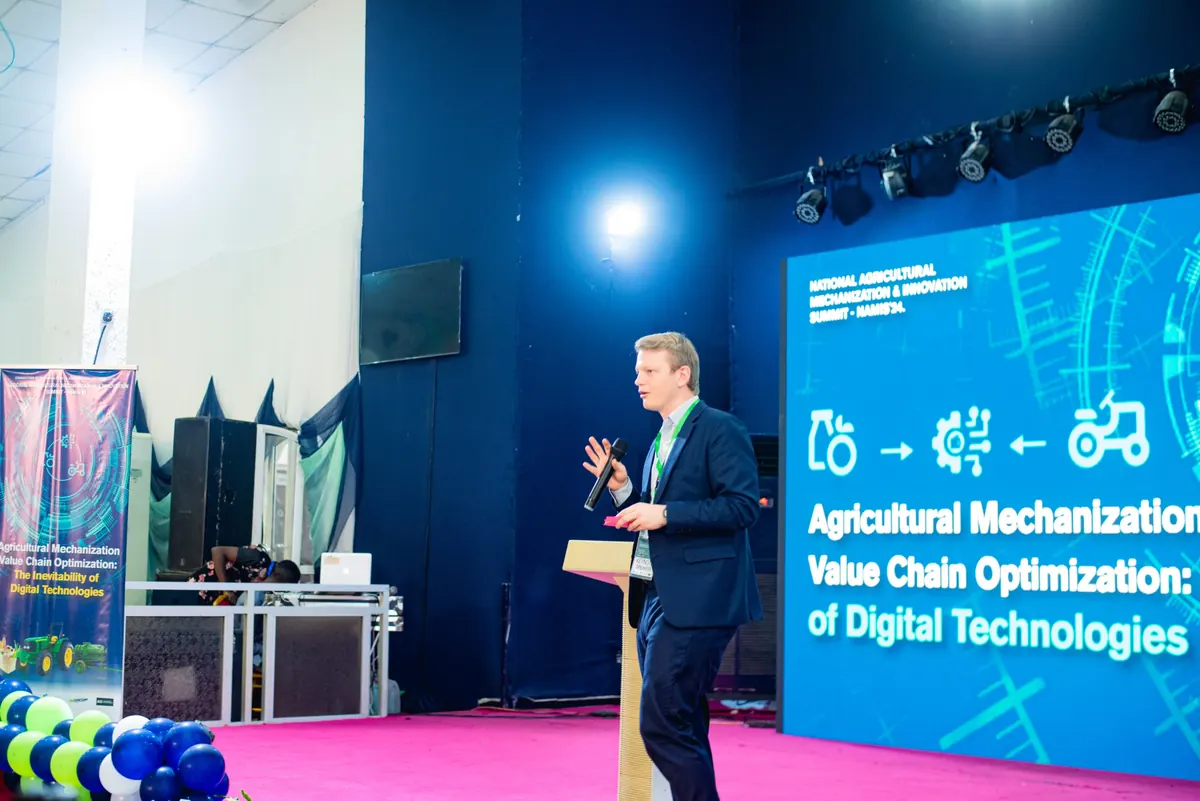
At NAMIS 2026, the live demonstration will take parts from file to finished component on the day.
References
- ARCN (2023) National Centre for Agricultural Mechanization (NCAM). Abuja: Agricultural Research Council of Nigeria. Available at: https://arcn.gov.ng/2023/01/
- BusinessDay (n.d.) 'NCAM urges cottage industries to commercialise agric research outcome', BusinessDay. Available at: https://businessday.ng/companies/article/ncam-urges-cottage-industries-to-commercialise-agric-research-outcome/
- ISO (1989) ISO 2768-1: General Tolerances, Part 1: Tolerances for Linear and Angular Dimensions without Individual Tolerance Indications. Geneva: International Organization for Standardization. Available at: https://www.iso.org/standard/7748.html
- ISO (2017) ISO 1101: Geometrical Product Specifications (GPS), Geometrical Tolerancing. Geneva: International Organization for Standardization. Available at: https://www.iso.org/standard/66777.html
- OEC (n.d.) Tractors in Nigeria: imports. Observatory of Economic Complexity. Available at: https://oec.world/profile/bilateral-product/tractors/reporter/nga