Sensors, data and the next generation of farm machines
The next generation of African farm machines will be judged on two things: the work they do and the data they report. Getting the second right means designing for the networks Africa actually has.
A fast-growing market that still reaches few farmers
The first continental survey of digital agriculture counted nearly 400 solutions and 33 million registered smallholders across sub-Saharan Africa, with registrations growing at around 45 per cent a year since 2012. Even so, it estimated that the market had reached only a small fraction of its potential (Tsan et al., 2019).
Connectivity is the constraint. In 2025, 63 per cent of Africa's population lived within mobile broadband coverage but did not use mobile internet (GSMA, 2026). A machine that needs a constant 4G connection will be blind in much of rural Nigeria.
Three kinds of data a farm machine can carry
| Data | What it tells you | Who uses it |
|---|---|---|
| Machine telematics: location, engine hours, fuel | Utilisation, theft risk, when service is due | Owners, service providers, lenders |
| Field operations: area worked, speed, depth | What was done, where, and how well | Farmers, cooperatives, programme managers |
| Agronomic sensing: soil moisture, pH, nutrients | What to plant, when to irrigate, how much fertiliser | Farmers, extension agents, input suppliers |
Nigeria is already using all three
Every tractor in the 2026 Renewed Hope programme carries IoT tracking that reports location, usage, fuel consumption and maintenance schedules (BusinessDay, 2026). That data is what lets a leasing model recover its cost. Hello Tractor built its tractor-sharing service around booking by text message and remote monitoring of each machine's work (Harvard Ministerial Leadership Program, n.d.). In Owerri, Zenvus developed in-soil sensors with built-in GPS that measure pH, nutrients, moisture and temperature; the company reports scaling the technology to 500,000 farming entities (CTA, n.d.).
Design principles for African conditions
- Store first, send later. Log locally and upload when a signal appears. Use SMS for alerts that matter.
- Power from the machine or the sun. A sensor that needs its own battery replaced each season will be abandoned.
- Use open standards. ISO 11783, widely known as ISOBUS, lets tractors and implements from different makers exchange data (ISO, 2017). Proprietary formats lock in a farmer who cannot afford one brand.
- Make data useful to the farmer, not only the lender. A field record that helps a farmer prove yields or secure credit will be valued and maintained.
- Agree who owns the data. Contracts should say whether the farmer, operator, financier or government may use it.
Where local manufacturing fits
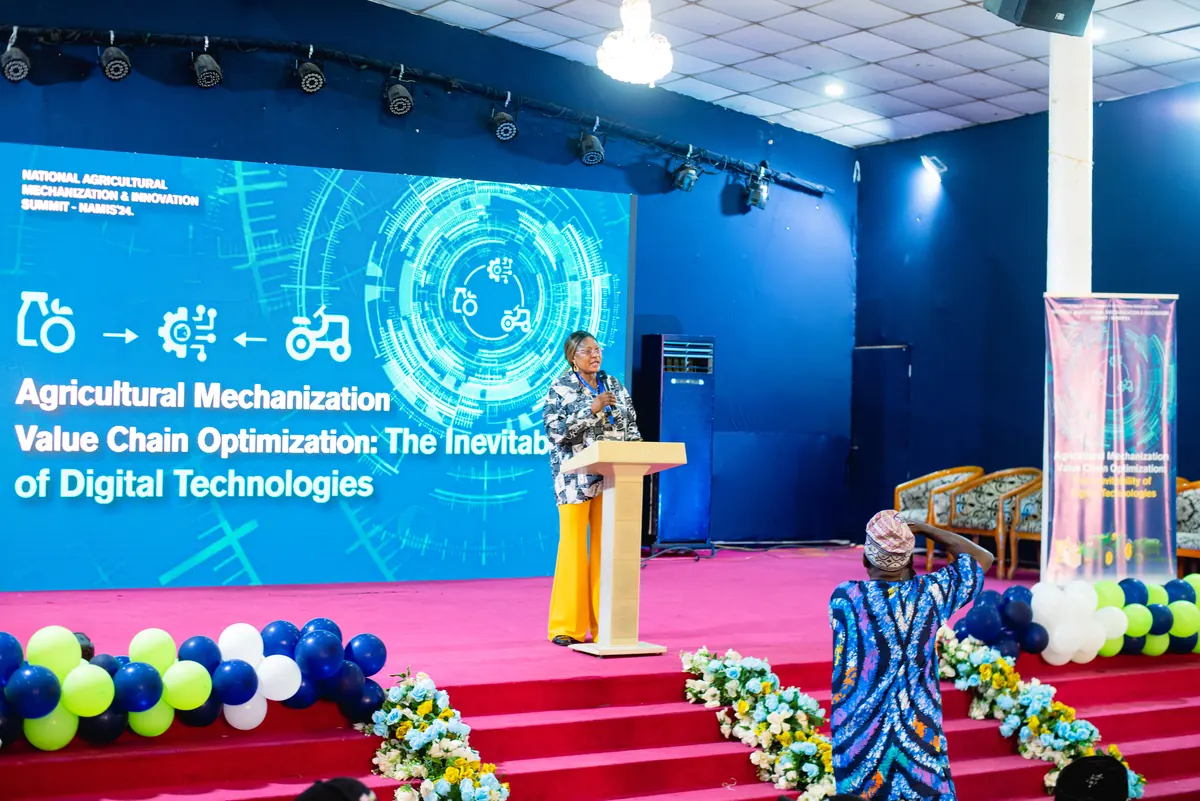
Sensor housings, mounts and brackets are well suited to local 3D printing and small-batch machining. A Nigerian workshop that can produce and replace them quickly gives a digital machine the same advantage as a mechanical one: someone nearby who can fix it. The 12:00 session at NAMIS 2026 brings precision agriculture, IoT and solution providers into the same room as the fabricators.
References
- BusinessDay (2026) 'FG flags off Africa's largest agricultural mechanisation programme, targets 1.2 million farmers', BusinessDay, 16 February. Available at: https://businessday.ng/agriculture/article/fg-flags-off-africas-largest-agricultural-mechanisation-programme-targets-1-2million-farmers/
- CTA (n.d.) 'Nigerian smallholders farm smart with soil data', Spore. Wageningen: Technical Centre for Agricultural and Rural Cooperation. Available at: https://spore.cta.int/en/innovation/all/article/nigerian-smallholders-farm-smart-with-soil-data-sid018de76a2-0945-428c-8b1c-9740ca852353.html
- GSMA (2026) The Mobile Economy Africa 2026. London: GSM Association. Available at: https://www.gsma.com/solutions-and-impact/connectivity-for-good/mobile-economy/wp-content/uploads/2026/06/The-Mobile-Economy-Africa-2026.pdf
- Harvard Ministerial Leadership Program (n.d.) Hello Tractor Case Study. Cambridge, MA: Harvard University. Available at: https://ministerialleadership.harvard.edu/leadership-resources/tech-database/hello-tractor-case-study
- ISO (2017) ISO 11783-1: Tractors and Machinery for Agriculture and Forestry, Serial Control and Communications Data Network, Part 1: General Standard for Mobile Data Communication. Geneva: International Organization for Standardization. Available at: https://www.iso.org/standard/57556.html
- Tsan, M., Totapally, S., Hailu, M. and Addom, B.K. (2019) The Digitalisation of African Agriculture Report 2018 to 2019. Wageningen: CTA and Dalberg Advisors. Available at: https://hdl.handle.net/10568/101498